

Get the ideal IPTV Service for HD & 4K streaming, live TV, sports, movies, and flexible multi-device entertainment in 2026.
Modern entertainment is no longer defined by fixed schedules, cable limitations, or switching between multiple platforms to find something worth watching. In 2026, users expect faster access, smoother playback, higher video quality, and the freedom to stream across different devices without interruptions. This shift has made IPTV Service one of the most popular streaming solutions for viewers looking for a more flexible and performance-focused entertainment experience.
Unlike traditional television models, a modern IPTV Service is built around internet-based content delivery, allowing users to access live channels, sports, movies, and on-demand entertainment through a more streamlined and responsive viewing environment. As streaming technology continues to evolve, factors such as stability, infrastructure quality, content accessibility, and viewing efficiency are becoming more important than simply having a large content library.
Today, viewers pay closer attention to how a platform performs in real-world usage rather than how many features appear on paper. Faster loading times, reduced buffering, consistent playback quality, and seamless multi-device experiences have become key expectations for modern streaming.
The growing demand for convenience has also changed how people consume entertainment. Instead of adapting daily routines around television schedules, users now prefer entertainment that fits naturally into their lifestyle and remains accessible anytime and across multiple screens.
As competition in digital entertainment continues to increase, choosing the right IPTV Service is becoming less about quantity and more about performance, usability, reliability, and long-term viewing satisfaction. A high-quality streaming experience today is defined by how effortlessly users can access and enjoy entertainment every day.
IPTV Service Latency Explained: Why Some Streams Feel Instant and Others Lag
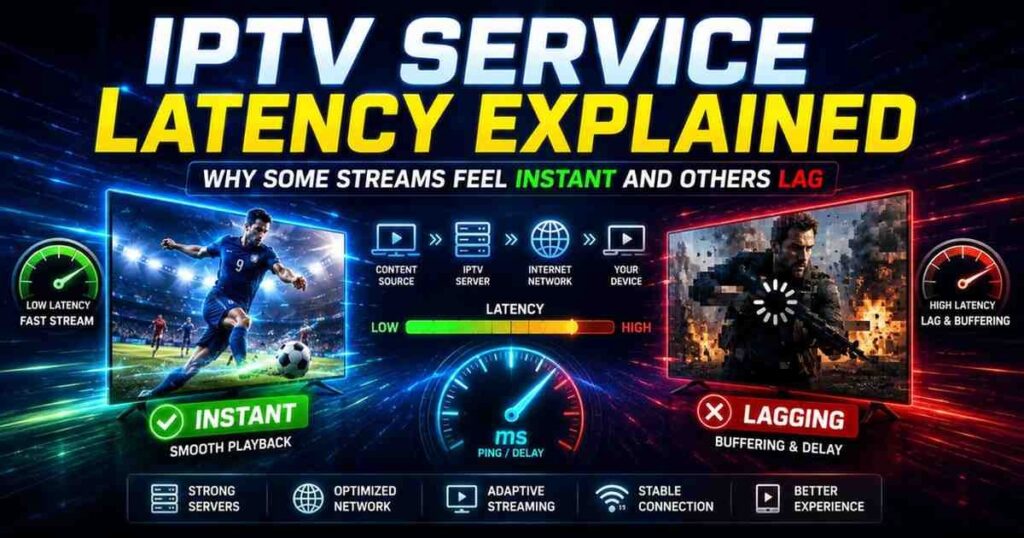
One of the biggest differences users notice while streaming is latency—the delay between selecting content and seeing it appear on screen. In an IPTV Service, latency directly affects how responsive and smooth the viewing experience feels, especially during live TV, sports broadcasts, and real-time entertainment.
Low latency creates the feeling that content loads instantly, while higher latency introduces delays that can make streams feel slower or less synchronized.
What Causes IPTV Latency?
Latency is created during multiple stages of content delivery. When a user starts a stream, the request travels through internet networks, reaches streaming infrastructure, processes video segments, and finally displays on the viewing device. Small delays at each stage can combine and become noticeable.
Common factors that affect latency include:
- Distance between users and streaming servers
- Network congestion during peak hours
- Content delivery routing efficiency
- Video encoding and compression speed
- Device processing performance
- Buffer management systems
Why Some Streams Feel Faster Than Others
A high-performing Best IPTV Service like Xtreme HD IPTV focuses on reducing unnecessary delays throughout the delivery process. Faster content delivery systems, optimized infrastructure, and efficient video processing can make channels load quicker and improve real-time viewing performance.
Live sports often make latency easier to notice. For example, users may receive notifications or hear reactions before the action appears on screen if stream delivery is delayed.
Buffering and Latency Are Not Always the Same
Many users assume buffering and latency are identical, but they affect viewing differently.
- Latency → Delay before content reaches the viewer
- Buffering → Interruptions caused during playback
A stream may play smoothly while still having noticeable delay.
How Better IPTV Performance Reduces Lag
Modern IPTV platforms improve responsiveness through:
- Smarter content delivery systems
- Adaptive bitrate streaming
- Faster server response times
- Stream optimization technologies
- Improved playback synchronization
As streaming expectations continue to rise, users increasingly evaluate an IPTV Service based on responsiveness and viewing consistency rather than content quantity alone. Lower latency creates a faster, smoother, and more immersive entertainment experience.
IPTV Service vs Multiple Streaming Apps: Which Creates a Better Viewing Experience?
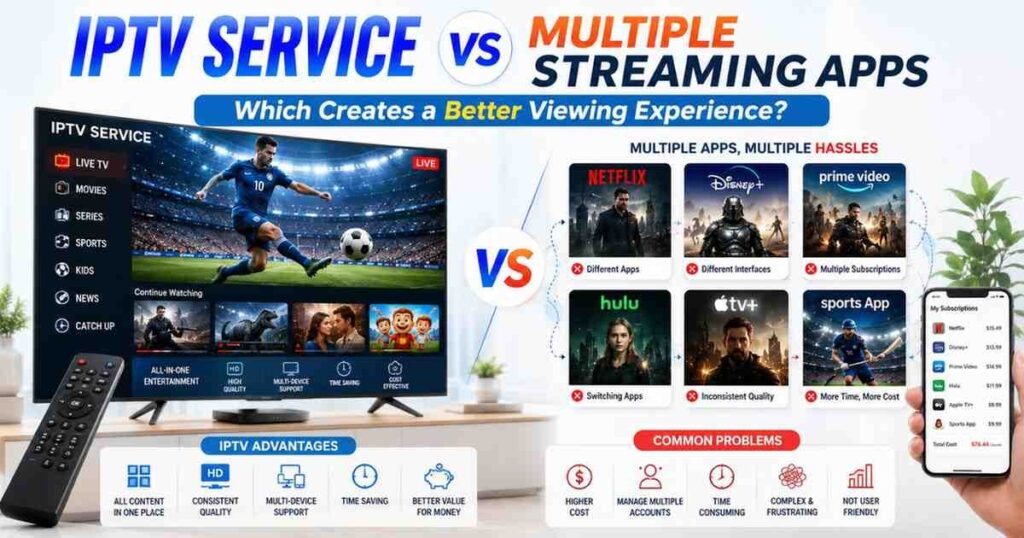
Entertainment habits have changed rapidly, and many users now find themselves switching between several apps just to watch live TV, sports, movies, and series. While this approach offers content variety, it can also create a fragmented viewing experience. This is where IPTV Service and multi-app streaming approaches begin to differ.
The Problem With Using Multiple Streaming Apps
Using separate platforms often means managing multiple subscriptions, different interfaces, separate watch histories, and inconsistent streaming performance. Users frequently move between apps to find content, compare quality, or continue watching across devices.
Common challenges include:
- Multiple monthly subscriptions
- Different content libraries across platforms
- Repeated sign-ins and account management
- Inconsistent video quality
- Device compatibility differences
- Slower content discovery
Over time, the experience can feel less convenient despite having access to more services.
How IPTV Creates a More Unified Experience
A modern or Best IPTV Service is designed to centralize entertainment into one viewing environment instead of separating content across multiple ecosystems. Rather than opening several applications, users can access different categories of entertainment through a more streamlined interface.
This creates advantages such as:
- Faster navigation between content types
- Reduced switching between platforms
- More consistent playback behavior
- Unified viewing experience across devices
- Lower friction during content discovery
Performance Matters More Than Quantity
Many viewers assume more apps automatically means better entertainment options. In reality, user experience often depends on efficiency. Opening fewer applications, reducing loading time, and minimizing interruptions can make streaming feel significantly smoother.
This becomes especially noticeable during live events and sports where speed and continuity directly affect viewing satisfaction.
Which Approach Fits Modern Streaming Better?
For users who prefer maximum content specialization, multiple streaming apps may still work well. But for viewers who value convenience, smoother access, and a more connected entertainment experience, an integrated IPTV Service model can reduce complexity and create a more efficient way to stream in everyday use.
As streaming continues to evolve, convenience and usability are becoming just as important as content availability itself.
Understanding Adaptive Bitrate Streaming in IPTV Service
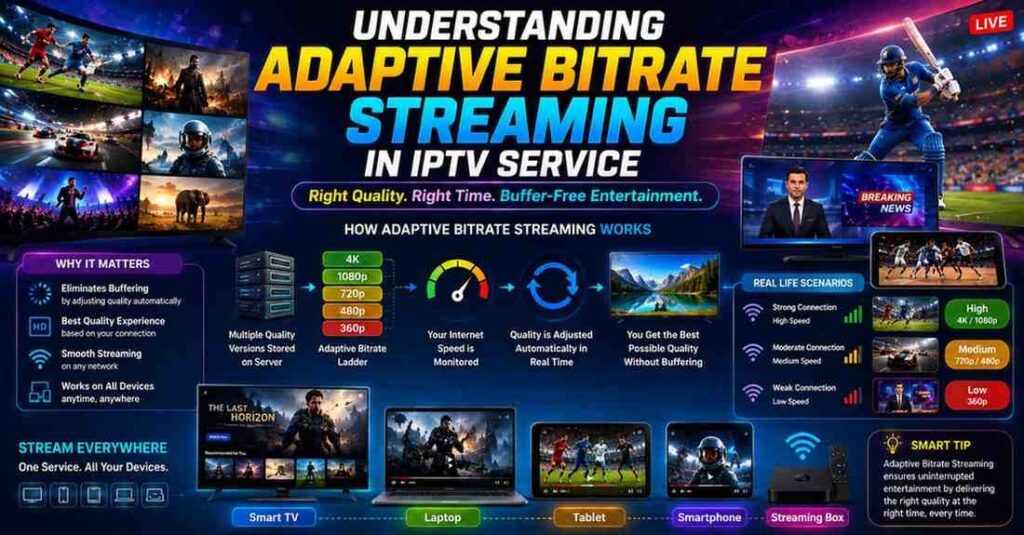
Adaptive Bitrate Streaming (ABR) is a core technology that allows an IPTV Service to deliver smooth and uninterrupted playback, even when internet speeds fluctuate. Instead of relying on a single fixed video quality, ABR dynamically adjusts the stream by switching between different resolutions in real time based on the user’s connection.
When the internet connection is strong and stable, viewers can enjoy high-definition or even 4K streaming with crystal-clear quality. However, if the connection speed drops or becomes unstable, the system automatically lowers the video quality temporarily. This helps prevent buffering interruptions and ensures that playback continues without frustrating pauses.
This intelligent streaming approach significantly enhances the overall viewing experience by maintaining consistency across different network conditions. It is especially important for users who switch between devices or use IPTV in varying environments, such as home Wi-Fi, mobile data, or public networks.
Adaptive Bitrate Streaming improves:
- Smoother and more consistent viewing experience
- Reduced buffering and interruptions
- Faster recovery when connection speed fluctuates
- Better performance across multiple devices and networks
A well-optimized IPTV Service leverages adaptive bitrate streaming to strike the perfect balance between video quality and playback stability. This ensures users can enjoy seamless entertainment, regardless of their internet conditions.
Why IPTV Service Performance Changes Across Different Devices
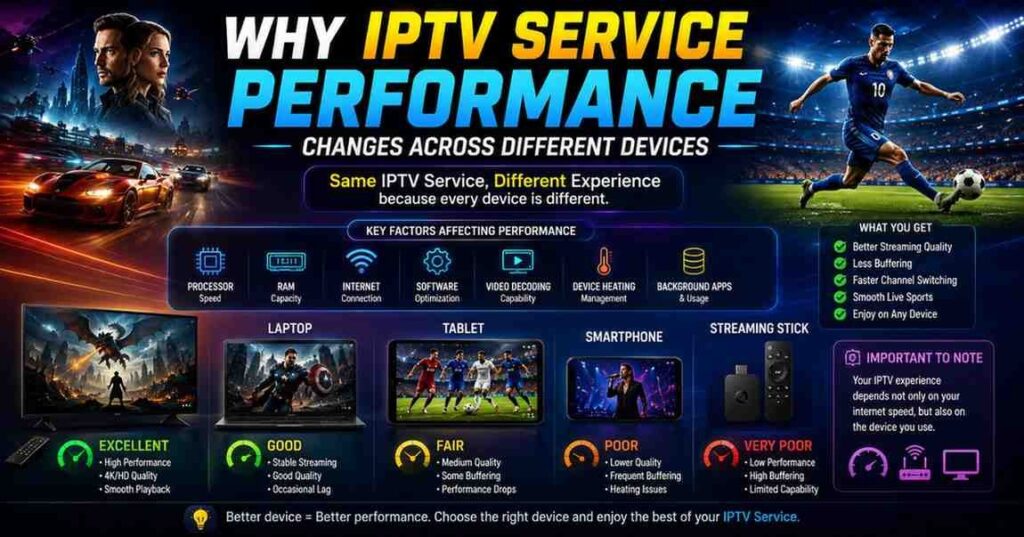
Many users expect the same streaming quality everywhere, but performance can vary significantly from one device to another. Even with the same internet connection, hardware and software differences affect how content is delivered and displayed.
Newer devices usually contain faster processors, better video decoding support, and more efficient memory management. This allows streams to load quicker, switch channels faster, and maintain stable playback.
Several factors influence performance:
- Processor power – Faster chips handle stream decoding more efficiently
- RAM availability – More memory helps reduce lag and interface slowdowns
- Display capability – Not every device supports HD, Full HD, or 4K equally
- Wi-Fi hardware – Better wireless modules improve connection stability
- Operating system optimization – Some platforms manage streaming apps more efficiently
- Background activity – Too many running apps can reduce performance
This is why a stream may feel smooth on a Smart TV but slower on an older mobile device or entry-level streaming stick.
A high-quality IPTV Service can optimize delivery, but the final viewing experience still depends heavily on the device receiving the stream.
IPTV Service Content Delivery Architecture
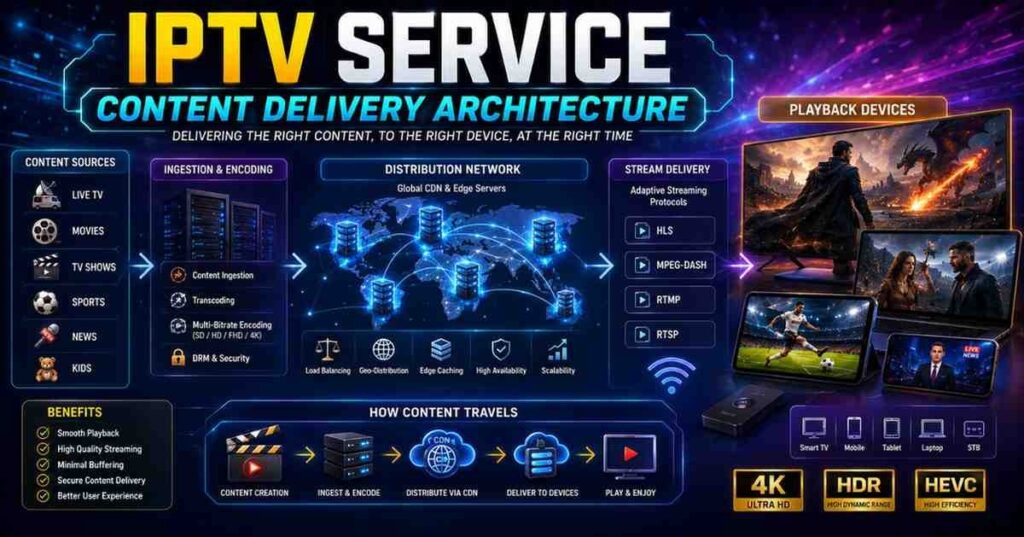
Behind every smooth streaming experience is a content delivery system designed to move video efficiently from source to viewer. IPTV Service content delivery architecture is the framework that controls how live channels, movies, and on-demand content travel across servers, networks, and devices while maintaining speed and quality.
The process usually starts at the content ingestion layer, where live broadcasts and media sources are collected and prepared for streaming. Content is then compressed and encoded into multiple quality levels so viewers can receive the most suitable version based on their connection speed and device capability.
After encoding, streams move into the distribution layer, often supported by edge delivery systems and geographically optimized servers. This reduces travel distance between content and viewers, helping minimize buffering, startup delays, and playback interruptions.
The final stage is the playback and delivery layer, where streaming protocols and device-side processing manage video rendering. Modern IPTV platforms also use intelligent caching, adaptive bitrate delivery, load balancing, and traffic optimization to keep performance stable during peak viewing periods.
A well-designed architecture does not simply deliver content faster — it creates a more consistent viewing experience across Smart TVs, streaming boxes, tablets, mobile devices, and desktops.
Hidden Causes of IPTV Service Buffering (That Are Not Internet Speed)
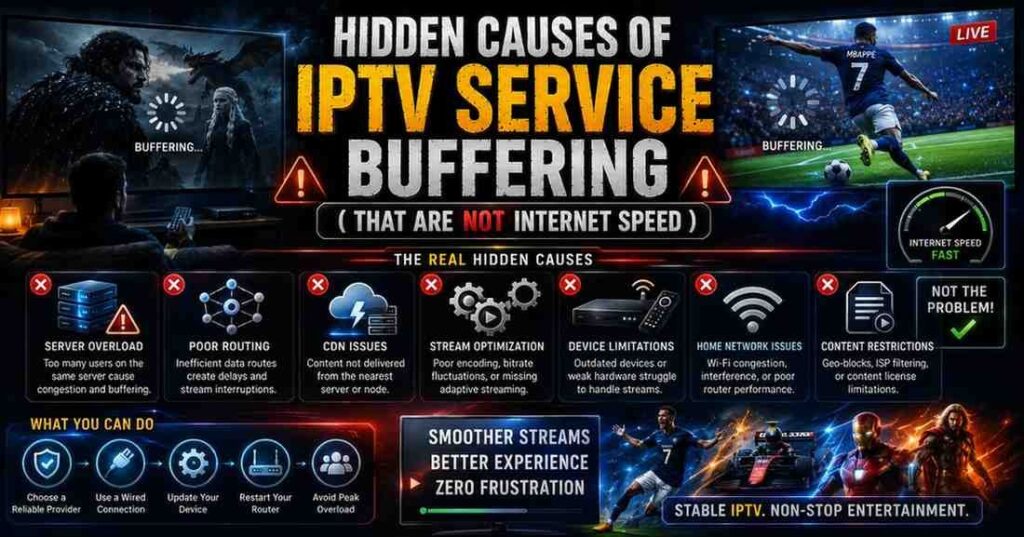
Many people assume buffering only happens because of slow internet, but that is often not the real reason. Even with fast connections, an IPTV Service can still experience interruptions because multiple technical layers affect playback.
1. Server Congestion
During peak viewing hours, overloaded streaming servers can delay content delivery and create buffering.
2. Device Processing Limits
Older Smart TVs, streaming sticks, or low-memory devices may struggle to decode HD and 4K content smoothly.
3. Poor Adaptive Bitrate Switching
If the video player changes quality levels too aggressively, playback can become unstable even on a strong connection.
4. High CDN Routing Distance
Content delivered from distant edge servers increases latency and may slow stream loading.
5. Video Codec Compatibility Issues
Some devices process modern compression formats less efficiently, creating lag despite available bandwidth.
6. IPTV App Optimization Problems
Not every streaming application manages memory, cache, and playback equally, which directly affects stability.
7. Local Network Bottlenecks
Wi-Fi interference, router overload, DNS response time, and too many connected devices can reduce streaming quality.
For long-term performance, choosing an optimized IPTV Service with efficient delivery systems, stable servers, and better device compatibility often matters more than simply upgrading internet speed.
IPTV Service During Peak Hours: What Separates Stable Platforms
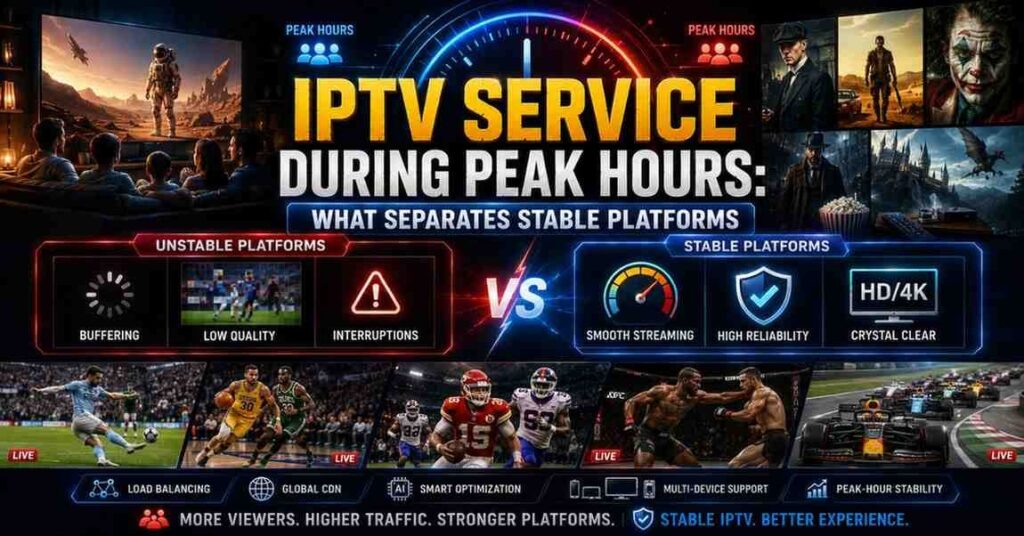
Peak hours are where streaming platforms reveal their real performance. A stream that works perfectly during the afternoon may behave very differently when thousands of users connect at the same time. That is why peak-hour stability has become one of the most important indicators of a quality IPTV Service.
One major factor is server load balancing. Stable platforms distribute traffic across multiple servers instead of sending all users through a single source. This helps reduce buffering, loading delays, and unexpected interruptions.
Another difference is content delivery infrastructure. Services with well-positioned delivery networks move streams closer to viewers, lowering congestion and improving response time during busy periods.
Stream optimization technology also plays a big role. Efficient bitrate adaptation, smart caching, and faster channel initialization help maintain smoother playback when demand spikes.
Device compatibility matters as well. Strong platforms optimize performance across Smart TVs, streaming sticks, mobile devices, and desktop systems instead of relying on one playback configuration.
During peak viewing events—especially sports, live broadcasts, and prime-time entertainment—the best experience usually comes from platforms built to handle traffic surges rather than simply offering higher advertised speeds.
IPTV Service Compression Technology and Visual Quality
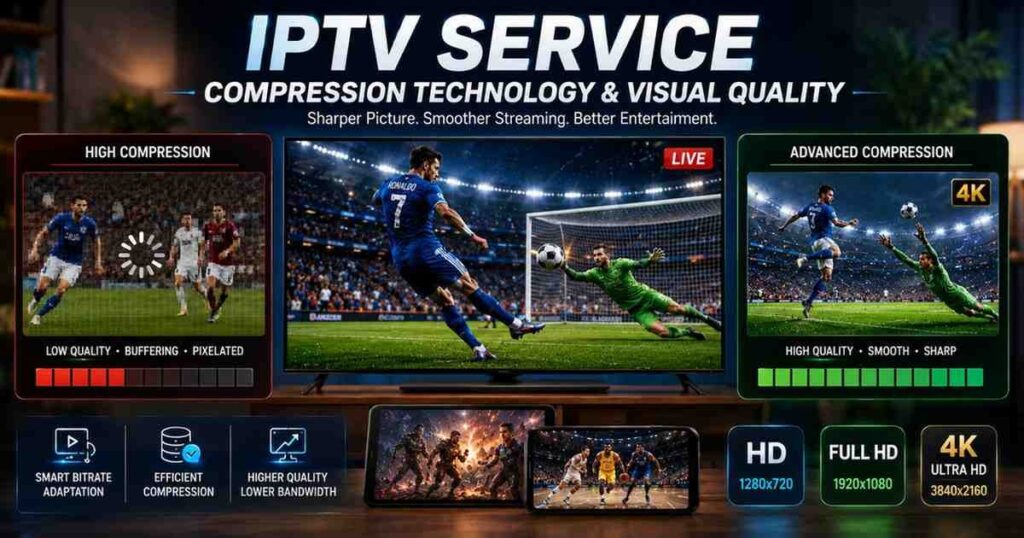
Streaming quality is not determined by resolution alone. Behind every smooth HD or 4K stream is compression technology that controls how video is processed, transmitted, and displayed. In an IPTV Service, compression directly affects picture sharpness, loading speed, bandwidth usage, and overall viewing quality.
Video compression works by reducing file size while trying to preserve visual detail. Without compression, streaming high-resolution content would require significantly more bandwidth and create slower playback.
Modern IPTV platforms commonly optimize compression to balance three goals:
- Maintain image clarity
- Reduce bandwidth consumption
- Improve playback stability
More efficient compression allows platforms to deliver smoother streaming while keeping data usage under control.
Several factors influence visual quality:
- Compression efficiency → Better detail retention with smaller file sizes
- Bitrate allocation → Higher bitrate generally preserves more image quality
- Motion handling → Fast scenes like sports require better compression accuracy
- Scene complexity → Dark environments and rapid movement are harder to compress
Compression becomes especially noticeable during live sports, action sequences, and high-motion content where poor optimization may create blur, artifacts, or loss of detail.
A well-optimized IPTV Service aims to preserve visual quality while maintaining stable performance, creating a viewing experience that feels sharper, smoother, and more consistent across different devices and network conditions.
Why Long-Term IPTV Service Quality Depends on Maintenance Cycles
Many people judge a streaming platform based on the first few hours or first week of use, but long-term performance is usually shaped by something less visible: maintenance cycles. An IPTV Service may perform well initially, yet consistency over months depends on how regularly the platform is maintained behind the scenes.
Maintenance cycles include server optimization, channel source updates, CDN balancing, database cleanup, infrastructure monitoring, playback testing, and software improvements. These processes help prevent common issues such as buffering spikes, broken channels, delayed loading, and quality drops during peak viewing periods.
Content sources also change constantly. Without ongoing maintenance, streams can become unstable, metadata may fail to sync correctly, and playback compatibility across devices can gradually decline.
Well-maintained platforms usually feel smoother over time because they continuously adjust capacity, improve routing efficiency, and optimize content delivery rather than waiting for problems to appear.
In the long run, users often remember reliability more than launch-day performance. A strong IPTV Service is not defined only by features—it is supported by consistent maintenance that keeps the viewing experience stable as demand grows.
Frequently Asked Questions
How does compression affect streaming quality?
Compression reduces video file size while trying to preserve visual detail. Better optimization usually results in smoother playback and clearer image quality.
Why do some streams look sharper than others even at the same resolution?
Resolution alone does not determine quality. Bitrate, compression efficiency, motion handling, and device processing all affect the final picture.
Does a higher bitrate always mean better streaming?
Not necessarily. Efficient compression and stable delivery can often create a better viewing experience than simply increasing bitrate.
Why does visual quality sometimes change automatically during playback?
Many modern platforms use adaptive streaming to adjust video quality dynamically and maintain uninterrupted viewing.
How does an IPTV Service maintain picture quality while reducing buffering?
A high-performing IPTV Service uses compression technology, bitrate optimization, and intelligent stream delivery to balance visual quality and playback stability.
Does device type affect IPTV playback quality?
Yes. Processing power, RAM, display capability, and hardware decoding support can influence loading speed, playback smoothness, and overall viewing quality.
Why does an IPTV stream perform differently during peak hours?
Peak-hour performance depends on factors like server load balancing, delivery infrastructure, traffic management, and stream optimization rather than internet speed alone.